Book Online You can request appointmentin 24 hours
Email : info@neurosurgery.com.pk
Phone : (042) 111 171 819
Best Congenital Craniospinal Disorders Surgeon in Lahore Pakistan
Neurosurgery > Best Congenital Craniospinal Disorders Surgeon in Lahore Pakistan
Congenital Craniospinal Disorders … Text in process
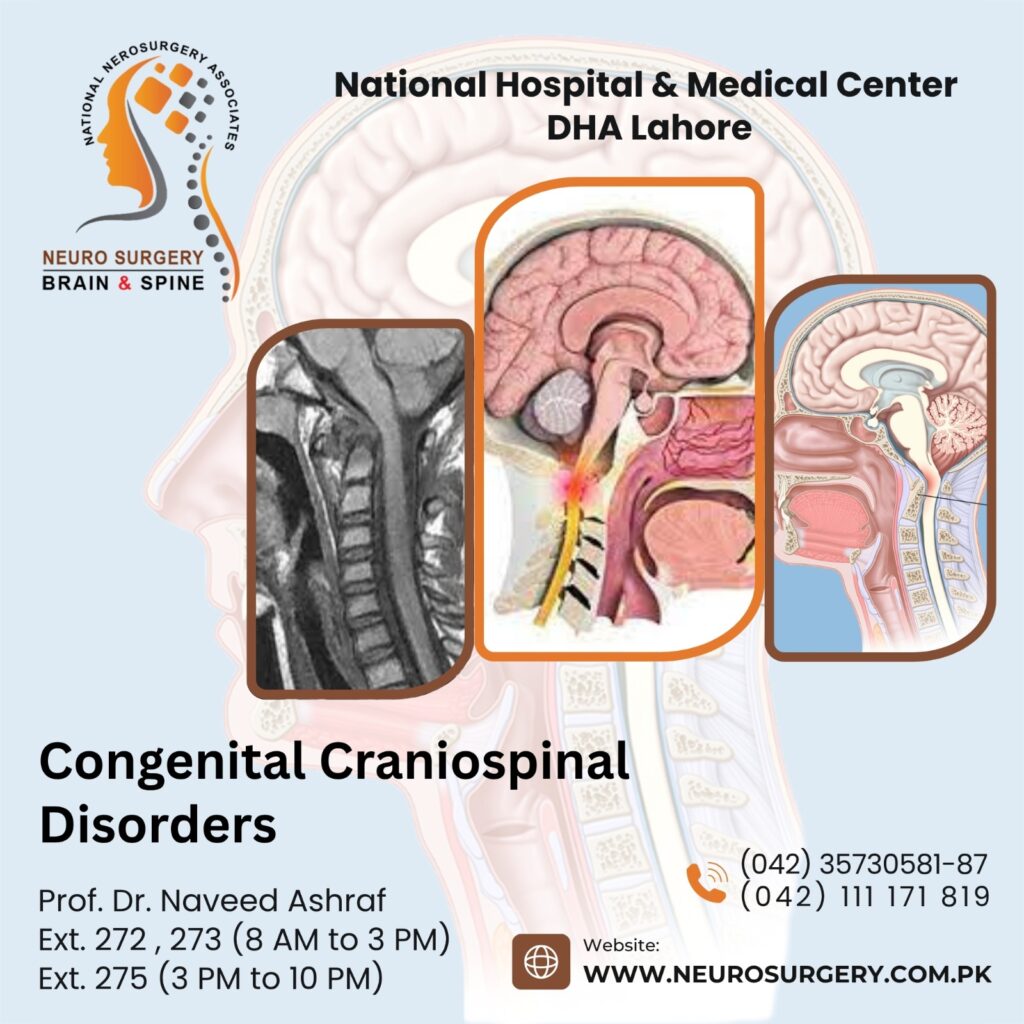
Congenital Craniospinal Disorders
They are group of disorders present at birth that affect the brain, spine, and associated structures. These disorders arise from abnormal development during embryogenesis and can lead to significant neurological, musculoskeletal and functional impairments.
1. Neural Tube Defects (NTDs)
Primary Headaches
Caused by incomplete closure of the neural tube during early development (3rd–4th week of gestation).
Anencephaly – Absence of major parts of the brain and skull; fatal. It occurs when the rostral end of neural tube fails to close between 23rd to 26th day following conception.
Spina Bifida – Incomplete closure of the spinal column:
Spina Bifida Occulta – skin-covered defect often asymptomatic ,patient presents with orthopaedic, urological or neurological issues. E.g lipomyelomeningocele,tethered cord, Diastamatomylia,dermal sinus.
Spina Bifida. Cystica
Meningocele – Meninges protrude through the spinal defect without neural tissue.
Myelomeningocele (most severe) – Neural tissue along with meninges protrudes through spinal defect causing paralysis, hydrocephalus, and bladder/bowel dysfunction.
Encephalocele – Brain tissue protrudes through a skull defect.
2. Chiari Malformations
Structural defects in the cerebellum and brainstem: it has different types eg chiari 0, 0.5,1,1.5,2,3 or 4.
Chiari I – Cerebellar tonsils herniate into the spinal canal; may cause headaches, syringomyelia. Usually presents in adult.
Chiari II (Arnold-Chiari) – Associated with myelomeningocele; involves brainstem herniation, hydrocephalus.
Chiari III & IV – Rare and severe, often fatal.
3. Craniosynostosis
Premature fusion of cranial sutures, leading to abnormal skull shape (e.g., scaphocephaly, plagiocephaly).
Chiari II (Arnold-Chiari) – Non-syndromic* – Isolated skull deformity.
4. Hydrocephalus
Excessive cerebrospinal fluid (CSF) accumulation in the brain, often due to:
Congenitalaqueductal stenosis – Blockage of CSF flow.
Dandy-Walker malformation* – Cystic dilatation of the 4th ventricle, hydrocephalus with cerebellar hypoplasia.
5. Syringomyelia & Hydromyelia
Fluid-filled cavities within the spinal cord, often associated with Chiari malformations or spinal cord tethering.
6. Tethered Cord Syndrome
Abnormal and low lying attachment of the spinal cord to surrounding tissues causing neurological deficits. In this condition cord is below its normal anatomical position (L1).
7. Congenital Vertebral Anomalies
Klippel-Feil Syndrome– Fusion of cervical vertebrae, short neck, limited mobility.